Signs Your Skin Is Losing Collagen (and What Helps)
By Liza Truter · 28 July 2026 · 5 min read
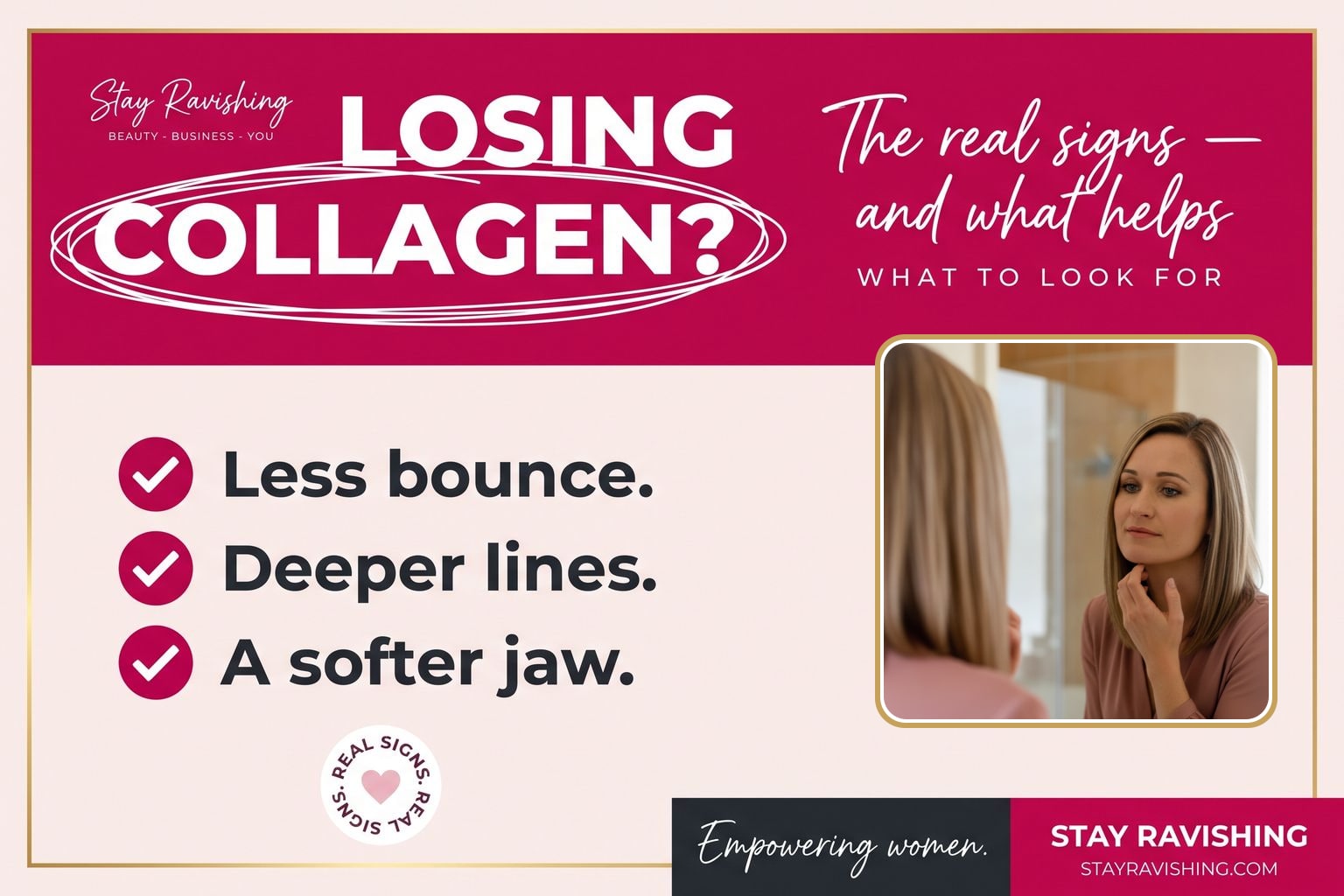
You catch yourself in the car mirror at a red robot, or in a photo someone tags you in, and something looks a little... softer. The jawline that used to be crisp has gone gently undefined. A line that was only there when you smiled now stays put. Your skin feels thinner, less springy, like it doesn't quite bounce back the way it used to.
If that's you, I want to say two things straight away. First, you're not imagining it. Second, you haven't done anything wrong. This is collagen — and understanding what's happening makes it so much less frightening, and so much easier to help.
What collagen actually is (in plain English)
Think of collagen as the scaffolding under your skin. It's the protein that keeps everything firm, plump and lifted — the mattress springs under the sheet. Alongside it sits elastin (the bounce) and hyaluronic acid (the water cushion). Together they're the reason young skin looks taut and full.
Here's the part nobody warns us about: from our mid-twenties we start losing a small amount of collagen every year. It's slow and invisible for a long time. Then, somewhere around our forties — and especially as oestrogen dips in perimenopause — the loss speeds up. Oestrogen helps your body make collagen, so when it drops, production drops with it. Studies suggest women can lose a meaningful chunk of their skin's collagen in the first few years around menopause. That's not vanity noticing a change. That's biology.
The real signs to look for
It rarely announces itself. It creeps. See if any of these feel familiar:
- Less bounce. Press a fingertip gently to your cheek and let go. Skin with plenty of collagen snaps back quickly. As it thins, it's a touch slower.
- Lines that used to be temporary. Expression lines that once vanished when your face relaxed now linger. Folds around the nose and mouth deepen.
- A softening jaw and jowls. The lower face loses its crisp edge. This is often the change that bothers women most, because it shifts the whole shape of the face.
- Thinner, more fragile skin. It can look a little crêpey on the neck, chest and backs of the hands, and bruise or mark more easily.
- A duller, flatter look. Less plumpness means less of that lit-from-within glow.
If you're also noticing more wrinkles arriving quickly, you might find my piece on why wrinkles appear faster after 40 helpful — it's the same story from another angle.
What breaks collagen down faster
Some collagen loss is just time and hormones, and there's grace in accepting that. But a big share is speeded up by things we can actually influence. The main culprits:
- Sun. By a mile, the biggest one. UV rays break down existing collagen and slow the making of new. Dermatologists reckon the majority of visible ageing is sun-related — which is wonderful news, because it's the most preventable.
- Sugar. Too much sugar triggers a process called glycation, where sugar molecules latch onto collagen and make it stiff and brittle. It loses its stretch.
- Smoking. It starves skin of oxygen and directly damages collagen and elastin. It's a huge reason skin looks older, sooner.
- Stress and poor sleep. Ongoing stress raises cortisol, which quietly breaks collagen down. Sleep is when your skin does its repairs — skimp on it and you skip the night shift.
Gentle, free ways to support your collagen
You don't need to overhaul your life. Small, kind, consistent habits do the heavy lifting:
- Wear sunscreen every single day — rain, shine, Highveld winter, all of it. This is the number one thing, full stop. If you're wondering whether it truly makes a difference, I dug into exactly that in does sunscreen prevent wrinkles.
- Eat for your skin. Colourful vegetables, enough protein, and vitamin-C-rich foods (guavas, citrus, peppers) give your body the building blocks for collagen. Ease back on the sugar where you can — you don't have to be perfect.
- Protect your sleep and your calm. Aim for proper rest, and find your own way to let the stress out — a walk, a bath, ten quiet minutes. Your skin feels it.
- Stay hydrated, inside and out. Well-cushioned skin looks fuller. Water helps; so does a good moisturiser that keeps it in.
Where the right skincare quietly helps
You can't rub collagen straight back in — but you can support the skin that's making it, and soften the look of what you've lost. This is where a targeted routine earns its place.
For a softening jaw and neck, the CRT Firming Face & Neck Cream is made for exactly that — a lightweight cream that targets sagging with an instant lift on the face and neck (we so often forget the neck). Pair it with CRT Youth Gel, which is clinically shown to increase firmness and elasticity in just one week, with an instant lifting effect. And to bring back tone and that glow, CRT Vitamin C Oil Serum helps even out colour and supports collagen, while shielding against premature ageing. A little goes a long way with these — a pea of cream, three or four drops of serum — so one bottle genuinely lasts months.
None of this is about chasing twenty-five again. It's about your skin looking rested, cared for and like you, at whatever age you are. That's always been the goal.
Not sure which concerns apply to your skin? Take our free 2-minute Skin Quiz for personalised skincare recommendations. 🌸