Why CND VINYLUX Lasts 7 Days (No Lamp, No Base Coat)
By Liza Truter · 17 August 2026 · 5 min read
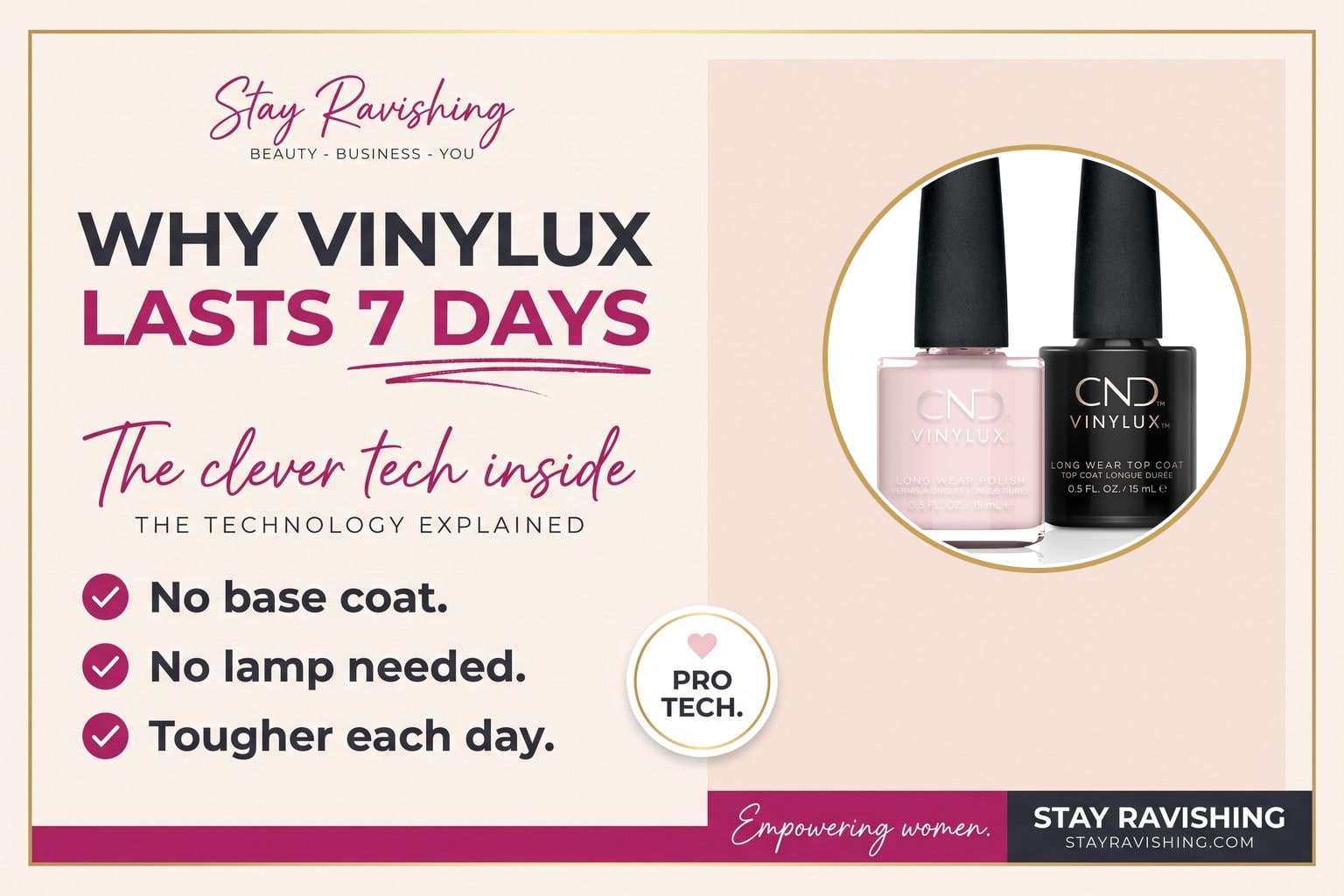
Most nail polish is a compromise. It looks beautiful on Saturday and tired by Tuesday, and you spend the rest of the week hiding your hands or picking at the edges.
CND VINYLUX was built to solve exactly that — and the way it does it is genuinely clever. It is not a gel, it does not go under a lamp, and it works in a way that is the opposite of everything you were taught about ordinary polish. Once you understand why, you will apply it better and it will last longer.
Two steps, not three
CND puts it plainly on their own site: VINYLUX "delivers week long wear — and care — in two simple steps." The system is an all-in-one base and colour coat plus a top coat, and CND is clear that the two "must be used together for ultimate performance."
A quick note on names, because bottles in circulation carry both: what CND originally launched in 2013 as VINYLUX Weekly Polish and Weekly Top Coat is now marketed as VINYLUX Long Wear Polish and Long Wear Shine Top Coat. Same system, two generations of labelling.
Why there is no base coat (and why adding one backfires)
This is the part that trips everyone up.
CND's launch announcement described VINYLUX as "a two-part weekly polish system that includes a self-adhering Color Coat which eliminates the need for a Base Coat." The grip comes from adhesion promoters built into the colour itself — CND's own product page credits them with dramatically improving adhesion and wear, "eliminating the need for a base coat." CND's UK site says it just as directly: VINYLUX is designed to adhere to the natural nail without a separate base coat.
So the colour coat is the base coat.
If you brush a base coat on first out of habit, you are laying a barrier between those adhesion promoters and the nail plate they were engineered to bond to. You are not adding protection. You are taking away the mechanism.
How it hardens — the bit people get wrong
VINYLUX does not cure. There is no lamp involved at any stage, and the word "cure" should never be used for it.
It dries the way polish dries: by solvent evaporation. CND's claim is that it is fully dry and ready to wear in 8½ minutes.
What happens next is the interesting part. The technology lives in the top coat, not the colour. CND calls it ProLight Technology, and describes it as creating "a network of cross-linked polymers that increase durability with exposure to natural light." CND also says the top coat prevents yellowing, protects the colour coat and delivers superior toughness.
In plain terms: the film keeps knitting together over the days you wear it, using ordinary daylight. Your manicure is at its toughest later in the week, not on day one.
To be very clear, because the internet gets this wrong constantly — it does not need sunlight to dry. It dries in 8½ minutes without a lamp and without sunlight. Daylight is what makes the finished film progressively harder.
Why the top coat is not optional
Now the whole system makes sense as one piece of engineering:
- The colour coat solves adhesion at the bottom — it grips the natural nail directly.
- The top coat solves durability at the top — it toughens as the week goes on.
Take either one away and you have an ordinary polish. That is why CND insists on both, and why the top coat over another brand's colour is not the tested system.
What the technology means for how you wear it
- Get the nail plate properly clean and dry. Oil, hand cream or cuticle oil left on the nail is the most common cause of early lifting. CND's own step is SCRUBFRESH.
- Two thin coats, never one thick one. Thick layers stay soft underneath and chip early.
- Cap the free edge on every layer — both colour coats and the top coat. That is usually the difference between day four and day seven.
- Respect the 8½ minutes. Most "it chipped immediately" stories are really dents from using your hands too soon.
- Do not add fresh top coat mid-week. CND does not recommend topping up; it works against the two-part system.
- Let your hands see normal daylight — that is ProLight doing its job.
There is more detail in how to make your VINYLUX manicure last and a full walkthrough in how to apply CND VINYLUX at home.
Removal is deliberately ordinary
Because nothing was cured, nothing has to be soaked off. CND's own wording: it "removes easily with regular acetone-based polish remover." No foil wraps, no timer, no filing. CND's remover for this is OFFLY FAST.
That is the trade-off against SHELLAC, which is lamp-cured, claimed at 14+ days, and must be properly soaked off. Same maker, deliberately different jobs — I have compared them properly in CND VINYLUX vs SHELLAC.
Honest expectations
CND's claim is 7+ day wear and chip-resistant — a performance claim under correct application, not a guarantee, and not chip-proof. VINYLUX is a nail polish with gel-like shine. It is not a gel, and it will not give you fourteen days.
Set against ordinary polish, though, it is a different category of product — which is what you would expect from a brand with its own research and development centre behind it. I have written about that side of things in why CND is a professional nail brand.
I list CND VINYLUX in 15ml bottles, with more than 50 shades and the Weekly Top Coat alongside them — current prices and delivery details are on the shop page.
Pick a colour you will actually be pleased to see on Friday, use both steps, and let the technology do the rest. Shop the CND VINYLUX range — and if you are not sure which shade or which system suits your nails, just ask me.